
Bryan County Court Records After a Jail Arrest
A Bryan County jail arrest usually starts in the custody system, then branches into the court system. The Bryan County Detention Center roster can show the booking charge, arresting agency, total bond, warrant number, misdemeanor or felony marker, and a court column. Those details are useful, but they are not the final criminal case record. After review, the Atlantic Judicial Circuit District Attorney, the Bryan County State Court Solicitor-General, or the appropriate court process determines what formal charges move forward.
The county court-file custodian is Clerk of Court Rebecca G. Crowe. The clerk serves Superior, State, and Magistrate Courts and maintains civil and criminal court files. For custody status, booking fields, and current jail population, use jail inmate records. For the booking-photo side of the same arrest, use jail roster mugshots. The court record is the place to confirm filed charges, hearing activity, pleas, dismissals, and disposition.
How to Find Bryan County Court Records After an Arrest
The official Bryan County State Court quick links include Bryan County Docket Search. That docket search is an official court-linked route, but the research environment could not verify its live field inventory, result columns, login requirements, or search behavior because the portal did not reliably render. Treat it as the official docket link, then confirm uncertain items with the clerk when a case result is incomplete or unavailable.
- Start with the Bryan County jail roster and write down the person's name, arrest date, arresting agency, warrant number, charge description, statute, misdemeanor/felony marker, bond field, and court column.
- Open the official Bryan County Docket Search and try the defendant name or case number if one is already known from court paperwork.
- If the roster points to Superior Court or the charge is a felony, look for a Superior Court criminal case and remember that the Atlantic Judicial Circuit District Attorney prosecutes felony matters.
- If the roster points to State Court, or the matter is misdemeanor, traffic, or ordinance based, use the State Court route and the Solicitor-General context.
- For warrant, first-appearance, preliminary-hearing, summons, or early bail issues, contact Magistrate Court because that court handles many initial criminal-process events.
State Court lists criminal deputy clerk Morgan Waters at 912-653-3875 for criminal matters. Magistrate Court can be reached at 912-653-3860. General courthouse information for Clerk Rebecca G. Crowe is listed in the research as 912-653-3872, and the State Court contact page lists the clerk at 912-653-3871. If an online search is unavailable, older, sealed, restricted, or non-indexed files may require clerk assistance rather than another roster search.
How Charges Get Filed After an Arrest: Complaint, Accusation, and Indictment
Booking charges are created at or near jail intake. Court charges are filed through a court process. In Bryan County, felony allegations generally move toward Superior Court and the Atlantic Judicial Circuit District Attorney. Misdemeanors, traffic violations, and county ordinance cases move through State Court and the Solicitor-General. Magistrate Court may create the earliest court records for warrants, preliminary hearings, and bail before the case settles into the final trial-court path.
| Charging Document | Who Uses It | What It Means After a Jail Arrest |
|---|---|---|
| Complaint or warrant paperwork | Law enforcement, prosecutor, or Magistrate Court process | Often explains why the person was arrested, booked, brought to first appearance, or held for a warrant-related event. |
| Accusation | Prosecutor | A prosecutor-filed charge document commonly used in Georgia criminal practice, including many State Court misdemeanor matters. |
| Indictment | Grand jury | A formal felony charging document returned by a grand jury, usually tied to Superior Court prosecution. |
| Redocketing or court order | Court clerk and judge | Can appear when a failure-to-appear warrant is recalled or a State Court case is placed back on the calendar. |
Charge Status in Court Records After an Arrest
A charge can change after the jail roster first displays it. The District Attorney or Solicitor-General may file a different charge, amend the wording, reduce the level, dismiss a count, or decline to continue prosecution. The safest reading is to treat roster charges as arrest or booking allegations until a court record shows the filed charge and later disposition.
| Status | What It Means |
|---|---|
| Pending | The charge has not reached final disposition. A hearing, plea, motion, indictment, accusation, or trial step may still be ahead. |
| Amended | The prosecutor or court changed the charge language, count, statute, or factual framing from an earlier version. |
| Reduced | The charge moved to a lesser offense or lower severity than the original booking or filed charge. |
| Dismissed | The charge ended without a conviction on that count, though other counts or related cases may still exist. |
| Nolle prosequi | The prosecutor declined to continue the charge. Georgia records may also describe this as nolle prossed. |
| No bill | A grand jury did not indict the charge presented to it. |
| Conviction | Guilt was adjudicated by plea or verdict. This is different from an arrest charge or pending accusation. |
Bond and Release After an Arrest
The Bryan County roster includes a Total Bond field, and sample records showed dollar amounts, NOT SET, and DENIED. That field helps families understand custody status, but it does not publish every reason a person may still be held. A no-set or denied indicator can involve a judicial decision, a pending first appearance, another agency hold, a probation or parole issue, a federal or immigration detainer, or a warrant in another jurisdiction.
Georgia misdemeanor bail guidance says misdemeanor defendants, including local ordinance defendants, have a right to pretrial bail or unsecured judicial release, and that initial appearance should occur as soon as possible and no later than 48 hours after a warrantless arrest or 72 hours after an arrest on a warrant. The same guidance says courts should consider conditions reasonably necessary for court appearance and community safety, including ability to pay. Local Bryan County payment methods, bond counter hours, and online bonding vendor details were not verified in the research.
| Bond Type | How It Works |
|---|---|
| Cash | Money is posted as security for appearance. Bryan County-specific accepted payment methods were not located. |
| Commercial surety | A licensed bondsman may post bond where allowed. No official local bonding-company list was verified. |
| Personal surety or recognizance | Release may be allowed through a noncommercial surety or unsecured promise to appear, depending on the judge and case. |
| No-bond hold | Release is not authorized until a court changes the hold or the holding agency clears the issue. |
Warrants That Lead to a Bryan County Arrest
No official Bryan County active-warrant search database was located. The sheriff's office serves criminal warrants, subpoenas, and civil process, and Magistrate Court handles arrest warrants, search warrants, preliminary hearings, summonses, and certain bail matters. Georgia warrant guidance says local sheriff access varies and may require a phone or in-person inquiry, usually with first name, last name, and date of birth.
Call the Bryan County Sheriff's Office in Pembroke at 912-653-3800 for local warrant or custody questions, or the Richmond Hill sheriff office at 912-756-2181 for South Bryan routing. Magistrate Court is 912-653-3860. When a warrant arrest results in booking, the jail roster may show a Warrant# column, statute, charge description, misdemeanor/felony marker, and court. The State Court redocketing form is also relevant because failure to appear can lead to an arrest warrant, and the form references a $75 redocketing fee in that specific State Court context.
Charges vs. Convictions
An arrest and a charge are not proof of guilt. Bryan County court records after a jail arrest should be read in stages: booking charge, prosecutor-filed charge, court status, and final disposition. A person may be arrested and never convicted, or may have some counts dismissed while another count is resolved by plea or verdict.
| Charge | Conviction | |
|---|---|---|
| Stage | Allegation listed at booking or formally filed in court. | Final guilt finding through plea or verdict. |
| Proof level | Can begin with probable cause or prosecutor review. | Requires proof beyond a reasonable doubt or an accepted guilty plea. |
| Where to verify | Jail roster, docket, clerk, DA, or Solicitor-General depending on stage. | Final court docket entry, sentencing order, disposition, or clerk-certified record. |
| Public meaning | Shows an accusation or pending matter. | Shows the case ended with guilt on that offense. |
Sealed, Restricted, and Expunged Court Records After an Arrest
Georgia uses record restriction under O.C.G.A. 35-3-37 for certain eligible criminal-history records. The Georgia Bureau of Investigation explains that restriction limits public criminal-history access for non-criminal-justice purposes when approved through the proper process. Georgia.gov also cautions that restriction does not permanently delete or destroy every record; judicial officials and criminal-justice agencies may still have access where the law allows. Many people use the word expungement for this process, but Georgia's practical public-record term is record restriction.
| Sealed or Restricted | Expunged Terminology in Georgia | |
|---|---|---|
| Public visibility | Public criminal-history access may be limited after approval. | Often used casually, but Georgia guidance emphasizes restriction rather than physical destruction. |
| Court file | Certain court access can still depend on court orders, statutes, and the specific record type. | Does not automatically mean every court, jail, or law-enforcement file disappears. |
| Eligible examples | Dismissal, nolle prosequi, no bill, acquittal, or other qualifying outcome may support a request. | Eligibility is case-specific and should be verified through the prosecutor, clerk, GBI, or legal counsel. |
| Who may still see it | Criminal-justice agencies and judicial officials may retain access under Georgia law. | Commercial website removal rules are a separate consumer-protection process. |
Background Check Considerations
Casual court lookup is different from a regulated background check. Court dockets and jail rosters can be incomplete, delayed, restricted, or changed by later case action. Employers, landlords, insurers, lenders, and other regulated users must use lawful consumer-reporting procedures instead of treating a roster charge or docket snippet as a complete background report.
Important: This private inmate-record resource is not a consumer reporting agency and cannot be used for FCRA-covered decisions.
Prosecutors for Court Records After a Bryan County Arrest
Felony prosecution for Bryan County is handled by the Office of the District Attorney for the Atlantic Judicial Circuit. The official DA site identifies Billy Joe Nelson, Jr. as District Attorney and lists 945 Elma G. Miles Parkway, Hinesville, GA 31313, with phone 912-876-4151. The circuit covers Bryan, Evans, Liberty, Long, McIntosh, and Tattnall counties.
The official Atlantic Judicial Circuit DA page is shown in the successful manifest capture from the District Attorney's website.

That prosecutor context matters when a roster charge is marked felony or points toward Superior Court, because the formal filed charge may differ from the arrest charge.
Misdemeanor, traffic, and county ordinance prosecution in Bryan County State Court belongs to the Solicitor-General's Office. The State Court Solicitor-General office lists Kailey Statham, Daniel Copas, and Jennifer Kyper at 912-653-5258. The office describes examples such as simple battery, simple assault, shoplifting, criminal trespass, DUI, speeding, and other traffic violations.
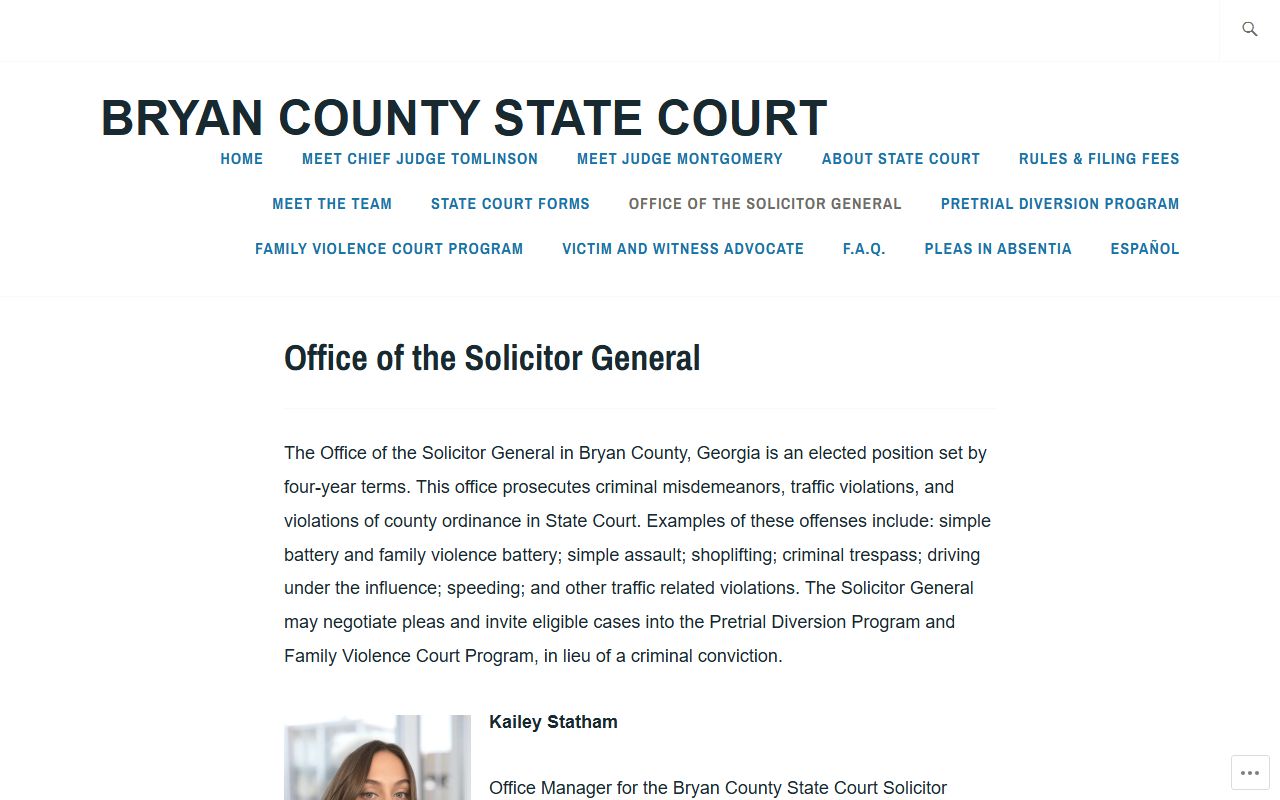
The Solicitor-General page appears in the successful capture from Bryan County State Court's Solicitor-General page.
For State Court criminal scheduling help, the specific criminal contact in the research is Morgan Waters at 912-653-3875. For early warrant or bail questions, Magistrate Court at 912-653-3860 may be the better first court contact.
Restricted Court Records After an Arrest in Bryan County
Some court records after an arrest may not appear in a public web search. Juvenile matters, sealed files, restricted criminal-history records, certain pending investigative materials, and non-indexed older records can require a clerk inquiry or a formal records request. Georgia court public-access rules generally treat court records as public unless limited by law or court order, while Georgia open-records guidance recognizes exemptions and requires a legal basis when records are withheld.
For sheriff or jail booking records, remember that Bryan County's county-level Open Records Officer role does not cover the Sheriff's Department, E-911, Tax Commissioner, Probate Court, or Clerk of Courts. Jail records and court records may therefore have different custodians. A written request should identify the defendant, arrest date, court, case number if known, and the exact court record or booking record sought.
Public Record Search
Sponsored Results